
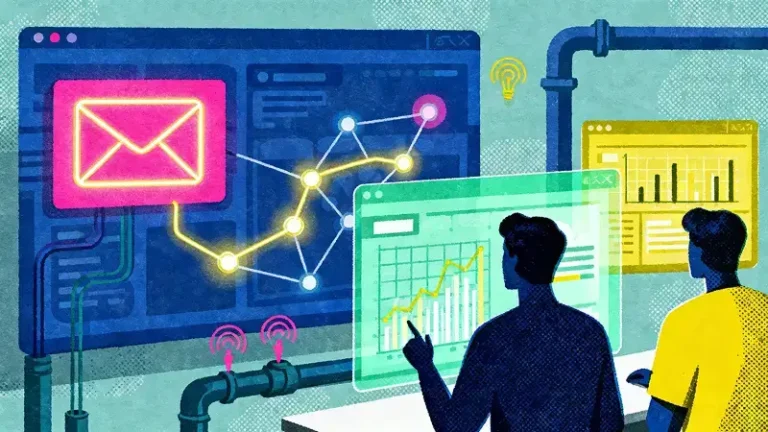
Email marketing gets pronounced “dead” about once every five years. Somehow, it keeps showing up to work. Today, it continues to drive pipeline, revenue, and more than a few executive dashboards. What has changed is not the channel, but the expectations. Email only works when it is closely tied to CRM marketing. On its own, it creates motion (at best.) When CRM-driven, it creates results.
Why Email Still Earns a Line in the Budget
Marketing teams have chased every shiny new channel over the years. Some worked briefly. Many did not. Email remains because it is owned, measurable, and does not disappear after the next algorithm update. The problem most teams face is not under-sending. It is over-enthusiasm. In 2026, the strongest email programs send fewer messages, and every one of them has a clear reason for existing.
CRM Marketing Is the Minimum Requirement
Email without CRM data is like driving with a paper map printed in 2009. It technically works, but not well, and not for long. Without lifecycle stage, engagement history, and sales context, emails arrive at the wrong time or repeat conversations that already happened. CRM marketing gives email a shared source of truth, which tends to reduce awkward moments across marketing and sales.
Campaigns Are Fine, Conversations Are Better
Campaigns still have their place. Product launches, announcements, and quarterly initiatives are not going anywhere. But campaigns alone do not produce steady growth. What does is ongoing, behavior-based communication that adjusts over time. CRM marketing enables this by connecting email activity with real customer behavior.
Campaigns make noise. Conversations build trust. Trust is what survives quarterly reviews.
Personalization That Respects Reality
Personalization used to mean adding a first name and hoping for the best. In 2026, it means reflecting actual context: industry, company size, engagement history, content interests, and sales status. When personalization is accurate, emails feel useful. When it is not, it feels like someone skimmed a spreadsheet and guessed.
Behavior Beats Guesswork
CRM marketing replaces hunches with signals. Page visits, content engagement, lead status changes, and pipeline movement indicate when communication is actually warranted. A well-timed, relevant email will outperform a beautifully written message sent at the wrong moment every time. Timing does most of the heavy lifting, and it does not require clever punctuation in the subject line.
Automation, Used Sparingly
Automation has earned its mixed reputation. Too often, it has been used to send more email instead of better email. High-performing teams in 2026 use automation with restraint. CRM-driven automation knows when to pause, adjust, or stop entirely. Sometimes the smartest workflow decision is leaving someone alone.
The Few Flows That Matter
Most teams do not need dozens of workflows. They need a small number that actually work: adaptive lead nurturing, sales follow-up aligned to pipeline stages, onboarding journeys that do not overwhelm, and re-engagement campaigns that respect timing. Complexity looks impressive in a demo. Simplicity tends to perform better in the real world.
Measuring What the Business Cares About
Open rates still have their place, but they are not the headline. In 2026, the metrics that matter are pipeline influence, conversion to opportunity, sales velocity, retention, and long-term engagement trends. CRM marketing makes these connections visible, which helps teams focus on results instead of celebrating activity.
Trust and Deliverability Are Not Optional
Email works because recipients trust it — until they don’t. Over-sending or irrelevant messaging erodes that trust quickly and usually shows up later as a deliverability problem no one remembers causing. Strong marketing strategies respect preferences, manage frequency, and stay aligned with intent. CRM systems make this manageable without turning compliance into a second career.
Executing These Strategies With Claritysoft
All of these strategies require a CRM built for how marketing teams operate today—not how enterprise org charts looked ten years ago. Claritysoft keeps contacts, companies, engagement history, and sales activity in one clear, connected system. That clarity makes smarter segmentation, behavior-based automation, and meaningful revenue reporting possible without adding complexity. When CRM marketing works, email becomes part of the revenue engine—not just another campaign tool. Claritysoft helps teams execute email marketing strategies for 2026 with clarity, control, and fewer emails that don’t need to exist.