

Most CRMs are built for volume.
More leads. More funnels. More automation.
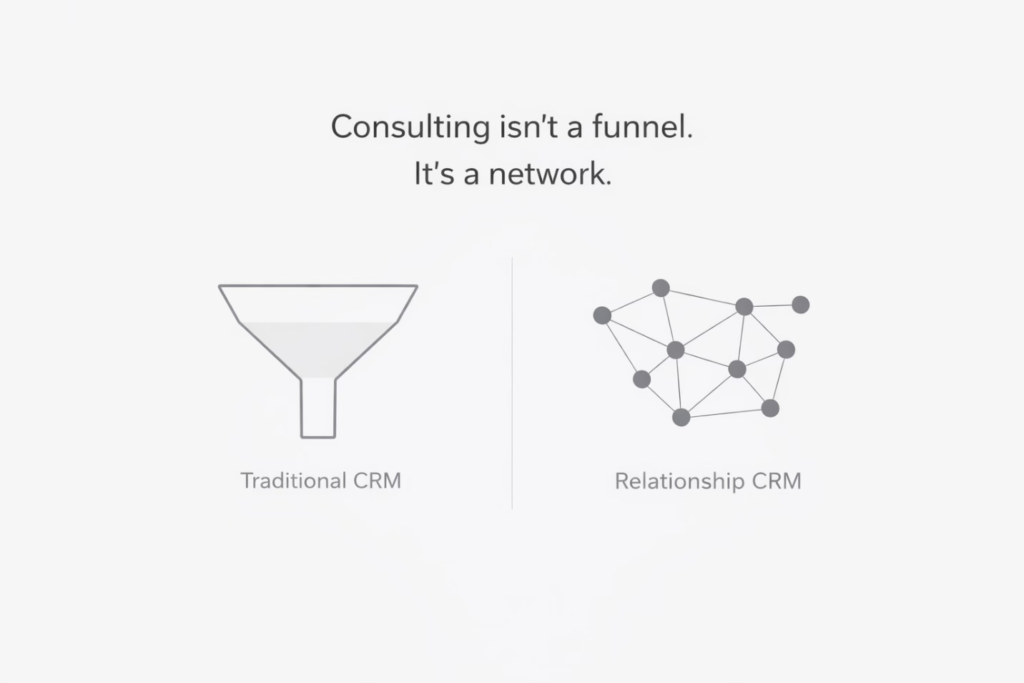
That model works for ad-driven growth and large sales teams. It does not reflect how most consultants grow.
Consulting businesses expand through relationships. Referrals. Repeat clients. One strong conversation that turns into introductions years later. Growth is personal and often unpredictable. This is where traditional CRMs begin to break down.
Consulting sales rarely follow a straight line. A former client calls with a new project. A referral surfaces months after an event. A “next quarter” conversation becomes a signed agreement a year later. A decision-maker changes companies and brings you along.
These relationships are long-term and high value. They do not behave like leads moving neatly through stages. When they are forced into rigid pipelines, context gets lost.
Most CRMs are optimized for capturing new leads, not preserving relationship history. Consultants care about engagement over time. Who introduced whom. What projects were delivered. Where trust was built. When that story is scattered across inboxes or buried in notes, continuity disappears.
Overly structured pipelines and aggressive automation only add friction. If updating the system feels like administrative work instead of strategic memory, it stops happening. And when updates stop, the CRM loses relevance.
A CRM for consultants should function as a relationship memory.
It should clearly show how you know someone, who referred them, what you have worked on together, and when you last connected in a meaningful way. Opportunity tracking should adapt to long timelines and informal discussions. Follow-ups should feel thoughtful, supported by reminders rather than impersonal automation.
Consultants win business by listening, remembering details, and building trust. Their CRM should reinforce those strengths.
A relationship-centered system protects institutional knowledge, maintains continuity as teams evolve, and supports referrals without reducing them to transactions. It aligns with how consultants already operate instead of forcing them into a high-volume sales model.
At Claritysoft, we design CRM for teams that value clarity over complexity. That means contact views built around relationships, flexible opportunity tracking, practical reminders, and an interface people actually want to use.
If your business is built on trust and long-term connections, your CRM should reflect that foundation.