

Most engineering firms did not invest in a CRM because they enjoy software.
They invested because spreadsheets failed, inboxes filled up, and no one knew who owned the next step.
So the system gets set up for lead tracking.
And that is where it stops.
For engineering firms, a CRM that only tracks leads is like CAD software that only draws basic shapes. It functions, but it does not support how real work happens.
Engineering Sales Is Not Linear
Engineering firms do not sell products. They sell expertise, trust, and long-term partnerships. Conversations unfold over months, sometimes years.
A single opportunity often includes multiple stakeholders across technical, financial, and operational roles. Proposals evolve. Site visits happen. Budgets shift. Projects pause and restart. Repeat business and referrals emerge without ever looking like traditional leads.
A simple pipeline cannot reflect that reality. When the system feels disconnected from how work actually moves, trust in the system declines.
The Cost of Pipeline-Only CRM
When CRM becomes a digital lead inbox, important information moves elsewhere.
Projects live in email threads.
Relationship history disappears when team members change roles.
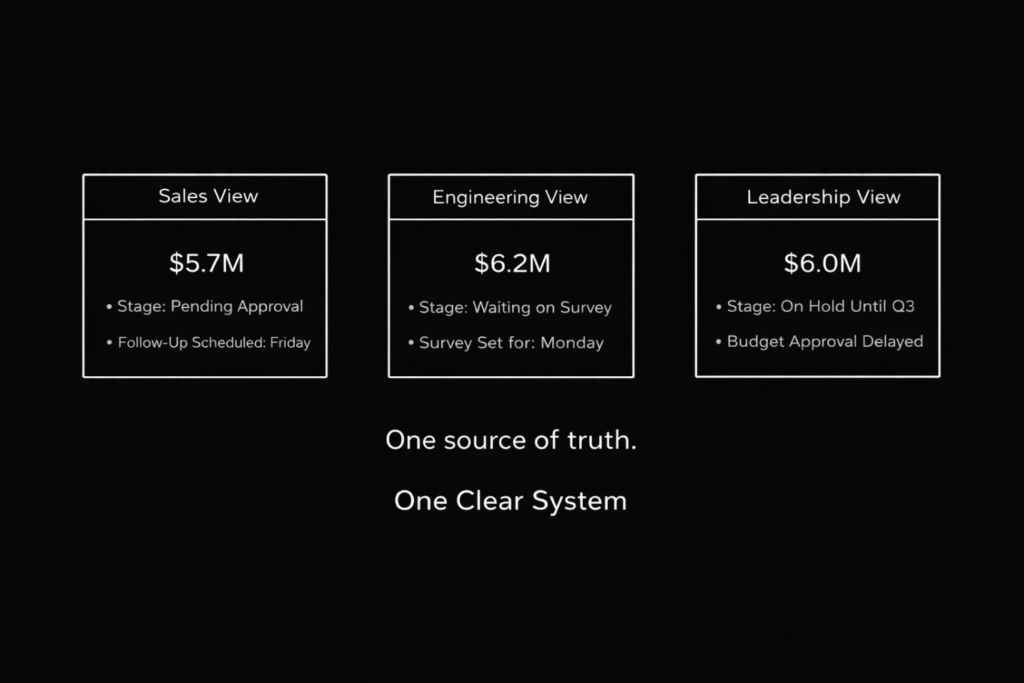
Sales, engineering, and leadership operate from different assumptions.
Forecasts become estimates rather than insights.
The CRM turns into a reporting obligation instead of a shared source of clarity. Once adoption drops, the data weakens. When the data weakens, decision-making suffers.
What Engineering Firms Actually Need
A CRM for engineering firms should support the full lifecycle of a client relationship, not just the first interaction.
It should provide clear visibility into client history. Every project delivered. Every proposal submitted. The internal team members involved. When context is accessible, follow-ups feel informed and professional.
It should capture opportunity context, not just stages. A deal is not simply qualified or negotiating. It may be waiting on survey results, pending budget approval, or paused until the next fiscal cycle. Understanding why something is stalled matters more than labeling where it sits.
It should enable collaboration across teams. Sales may initiate the conversation, but engineers contribute expertise that shapes the outcome. A useful CRM makes it easy for engineers to add insights, for leadership to assess workload and risk, and for teams to stay aligned without constant meetings.
It should provide long-term visibility. Engineering firms succeed by maintaining relevance over time. Leaders need to understand which clients are growing quiet, where referrals originate, and which relationships warrant deeper investment. That perspective comes from connected data, not isolated leads.
Adoption Matters More Than Features
Many engineering firms already own capable CRM platforms. They simply are not used consistently.
Too many fields.
Too much automation.
Too many dashboards that add noise instead of clarity.
If the system feels burdensome, it gets avoided. Incomplete data leads to unreliable reporting. A powerful platform becomes an expensive guessing tool.
Clarity consistently outperforms complexity.
CRM Should Support Engineering Work
The right CRM aligns with how engineering conversations unfold. It recognizes that not every contributor identifies as a salesperson. It makes collaboration easier and improves visibility without overwhelming users with metrics that do not matter.
When CRM aligns with real workflows, it stops being sales software and becomes operational infrastructure.
Where Claritysoft Fits
Claritysoft was designed for professional services teams that have outgrown basic lead tracking but do not want enterprise complexity.
It connects contacts and companies.
It links opportunities with projects.
It brings communication history and follow-ups into one clear system.
No unnecessary layers.
No clutter that discourages use.
Just a CRM built to support how engineering firms build relationships, collaborate across teams, and grow over time.