(So You Don’t Regret It Six Months Later)
Buying a CRM should feel like progress.
Too often, it feels like a very expensive lesson.
Most CRM mistakes don’t come from bad intentions. They come from asking the wrong questions, or trusting answers that only work in demos, not in daily life.
Before you sign a contract, sit through another pitch, or get dazzled by dashboards and AI promises, here are the questions that actually determine whether a CRM will move your business forward or quietly hold it back.
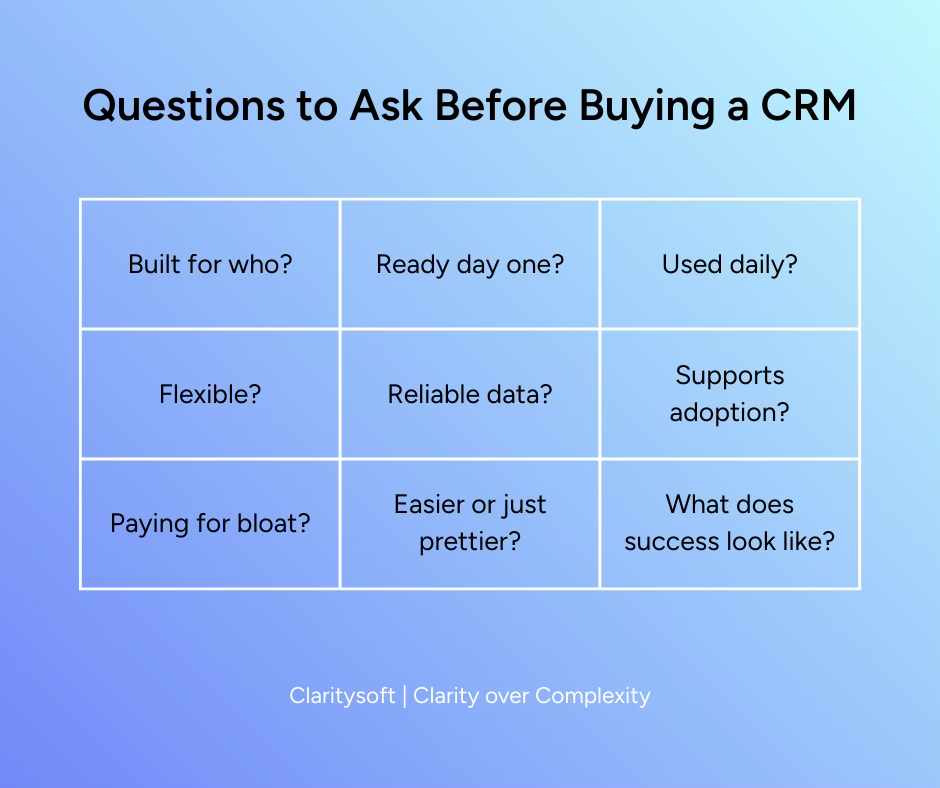
1. Who Is This CRM Actually Built For?
This sounds obvious. It rarely is.
Ask:
• Is this CRM designed for companies our size?
• Or is it built for enterprises with dedicated admins and operations teams?
Many CRMs are optimized for complex organizations and sold to smaller businesses anyway. The result is a system full of features you do not need and workflows that do not match how your team works.
If the CRM assumes you have a full-time administrator, that is a warning sign.
2. How Much Setup Is Required Before It’s Usable?
Every CRM requires setup. The question is how much.
Ask:
• Can we start using this immediately?
• What is required before day one?
• What happens if we skip certain configurations?
If the answer involves weeks of setup, consultants, or rigid “best practices,” understand what that really means. Value is delayed until everything is perfect.
Most teams want tools that work while they are still figuring things out.
3. What Will Employees Actually Use Every Day?
This is the most important question, and the most overlooked.
Do not ask what the CRM can do. Ask:
• What will my team realistically use?
• What will they ignore?
• What will they quietly avoid?
If a CRM feels heavy, confusing, or time-consuming, employees will not protest. They will simply stop using it properly.
A powerful CRM that people do not like using becomes expensive shelfware.
4. How Does This CRM Handle Change?
Your business will change. Guaranteed.
Ask:
• Can we adjust workflows as we grow?
• Can we add or remove fields without breaking things?
• How flexible is reporting as priorities shift?
Some CRMs are flexible in theory and brittle in practice. Small changes turn into big projects. Teams stop improving the system because it feels risky.
The best CRM adapts as your business evolves.
5. How Reliable Will the Data Be?
Dashboards are only as good as the data behind them.
Ask:
• How does this CRM encourage consistent data entry?
• What happens when people skip fields or rush updates?
• How easy is it to see the full customer picture?
If the system is hard to use, data quality will suffer. That leads to misleading reports, inaccurate forecasts, and AI insights built on incomplete information.
No amount of analytics can fix bad inputs.
6. What Happens When Adoption Drops?
Because it will, at least a little.
Ask:
• How does this CRM support long-term adoption?
• Is it forgiving of imperfect usage?
• Does it guide behavior or punish mistakes?
CRMs that require perfect processes tend to lose adoption over time. CRMs that support how people actually work tend to stick.
This difference shows up months after purchase, not during the demo.
7. How Much Are We Paying for Features We Will Not Use?
CRM pricing is rarely about what you need. It is about what is bundled.
Ask:
• Which features are included by default?
• Which ones are actually used by companies like ours?
• What are we paying for just to check a box?
If half the platform sounds impressive but irrelevant, you are likely paying for complexity, not value.
8. Will This Make Work Easier or Just Look Smarter?
This is the gut-check question.
Ask:
• Will this reduce effort for employees?
• Will it make decisions clearer for leadership?
• Or will it just look impressive in meetings?
A good CRM fades into the background.
A bad one demands constant attention.
If the system makes people slower, more cautious, or more frustrated, the ROI math will never work.
9. What Does Success Look Like After 6–12 Months?
Zoom out.
Ask:
• What will be better day to day?
• How will we know this was the right decision?
If the answers are vague or focused only on future potential, that is a risk.
Real CRM value shows up in clearer workflows, better visibility, and less friction.
Why These Questions Matter
CRMs do not fail because they lack features.
They fail because they ignore human behavior.
If employees do not enjoy using the system, data quality drops.
When data quality drops, dashboards lie.
When dashboards lie, decisions suffer.
When decisions suffer, ROI disappears.
That is not a technology problem.
It is a usability problem.
Why Claritysoft Takes a Different Approach
Claritysoft is built around one guiding principle.
If people do not use the CRM, nothing else matters.
That is why Claritysoft focuses on intuitive workflows, flexible customization, trustworthy reporting, and features that support real work, not just demos.
Instead of asking businesses to adapt to the software, Claritysoft adapts to the business.
Ask Better Questions. Buy Smarter Software.
Choosing a CRM is a long-term decision.
The right questions upfront prevent years of frustration later.
If you want a CRM that prioritizes clarity, adoption, and real ROI without the bloat, Claritysoft is built to fit how growing businesses actually operate.
Because the best CRM is not the one with the longest feature list.
It is the one that makes work easier every single day.