In today’s unpredictable economic climate, businesses are tightening budgets, reassessing priorities, and demanding every technology investment prove its worth. Yet amid cost-cutting pressures, one tool stands out as not just defensible but essential: Customer Relationship Management CRM.
A CRM system does more than organize contacts. It centralizes data, aligns teams, improves customer experiences, and drives measurable business outcomes. In periods of economic uncertainty, those capabilities aren’t luxuries they’re strategic advantages.
Here’s why investing in CRM now can boost resilience, revenue, and long-term growth.
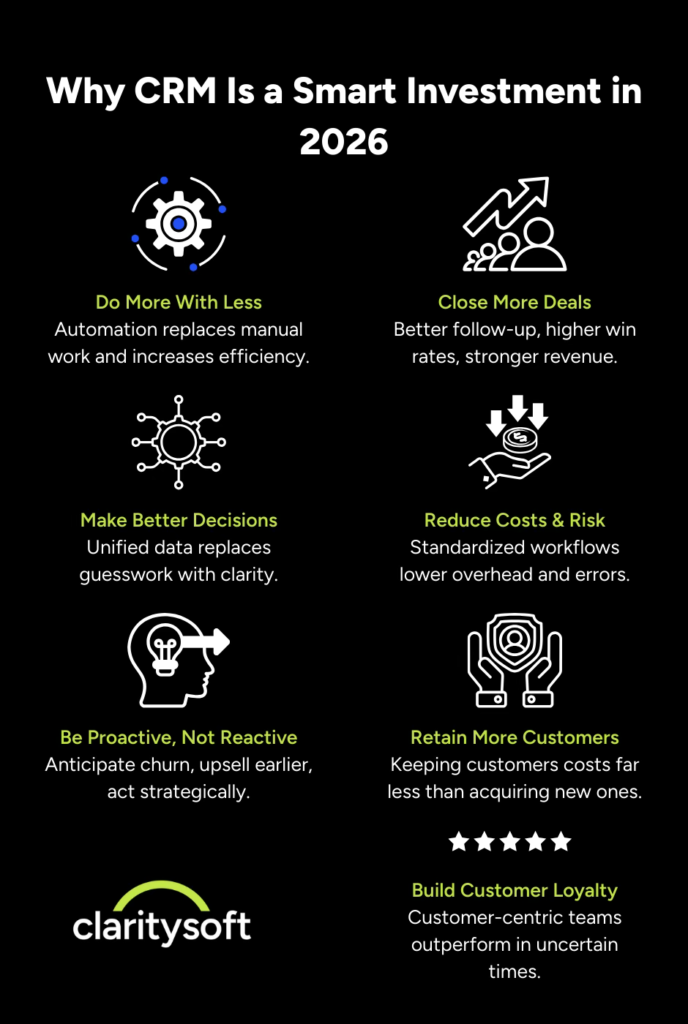
1. CRM Helps You Do More With Less
Economic downturns force companies to rethink how they operate. Instead of throwing more budget at marketing or headcount, leaders must extract more value from existing resources.
A robust CRM automates routine tasks across sales, marketing, and support reducing manual work and freeing teams to focus on higher-value activities. Automations such as lead routing, follow-up reminders, and customer segmentation reduce cycle times and improve efficiency, directly saving time and money.
Moreover, integrating CRM with real-time data allows teams to make rapid, informed decisions a key advantage when market conditions shift quickly.
2. Retaining Customers Is Cheaper Than Finding New Ones
In times of economic uncertainty, focusing on existing customers isn’t just smart it’s cost-effective.
Multiple industry sources show that acquiring a new customer often costs significantly more than keeping an existing one. Businesses typically spend much more on marketing, sales outreach, and onboarding for new customers while retention efforts like service, engagement, and upselling cost far less and deliver stronger profit impact. In fact, research indicates that acquiring a new customer can cost up to five times more than retaining an existing one meaning that companies can drive greater ROI by nurturing current relationships.
A CRM system gives teams a centralized view of customer history, preferences, and interactions, enabling more effective retention strategies, proactive outreach, and personalized service that keep customers loyal and spending. This isn’t just good practice it’s sound economics when budgets are tight and every dollar must deliver measurable value.
3. CRM Drives Better Decision-Making With Unified Data
When budgets are tight, leaders need to know what’s working and what’s not fast.
CRM platforms centralize customer and sales data into a single dashboard, offering clarity into pipeline health, campaign performance, and revenue trends. This data visibility helps leadership allocate resources more effectively, forecast future revenues with more confidence, and react strategically to emerging opportunities or risks.
Organizations without this unified view are often flying blind especially dangerous in a volatile economy.
4. Close More Deals and Improve Win Rates
There’s strong evidence modern CRM technology contributes to real revenue growth, even during economic slowdowns.
Research shows CRM adoption can increase sales win rates and accelerate topline growth by enabling sales teams to better qualify leads, track follow-ups, and close opportunities more consistently. Analyst data indicates CRM technology can boost revenue by up to nearly 30% while improving productivity and reducing labor costs.
That’s not about spending more it’s about capturing more value from every opportunity.
5. CRM Reduces Operational Costs and Risk
Investing in a CRM also helps streamline operations across departments:
- Automation cuts down manual work and errors.
- Standardized workflows reduce training time.
- Real-time data decreases forecasting risk.
- Centralized systems cut software sprawl.
When every dollar has to stretch further, reducing waste and risk becomes a competitive advantage. A well-implemented CRM can lower costs while simultaneously improving performance.
6. CRM Enables Proactive Engagement Not Just Reactive
In uncertain times, reactive businesses lose ground. The brands that thrive are proactive anticipating customer needs, anticipating churn risk, and nurturing relationships before problems arise.
Modern CRM platforms use analytics and automation to identify patterns, predict behaviors, and prompt timely outreach. Whether it’s flagging high-value accounts that are slipping or suggesting upsell moments, CRM helps teams act strategically rather than reactively.
7. It Supports a Customer-Centric Strategy A Core Differentiator
A CRM is more than a technology purchase; it’s a commitment to customer-centric operations.
Studies show that organizations with strong customer relationships outperform competitors because they deliver more relevant experiences, faster problem resolution, and higher satisfaction levels. CRM systems are fundamental to that customer-centric model because they consolidate data, personalize engagement, and unify teams around a shared understanding of the customer.
In uncertain economic times, customer loyalty isn’t a nice-to-have it’s a pressure valve that can keep revenue stable when acquisition slows.
Conclusion: CRM Isn’t Just Technology It’s Strategy
Investing in CRM during economic uncertainty isn’t a cost it’s a strategic move that strengthens resilience, aligns teams, powers smarter decision-making, and protects revenue.
Economic downturns often spell out winners and losers in any market. Companies that double down on customer experience, data-driven operations, and team efficiency are better positioned to grow even when conditions are tough.
CRM isn’t just about managing contacts. It’s about managing growth intelligently, sustainably, and with clarity.