Customer experience doesn’t start on your website.
It starts inside your systems.
When internal tools are hard to use, people work around them. Data becomes incomplete. Processes drift. Customers never see the software, but they feel the consequences in missed follow-ups, inconsistent communication, and slow responses.
Internal tools, especially your CRM, should be the easiest software in your organization.
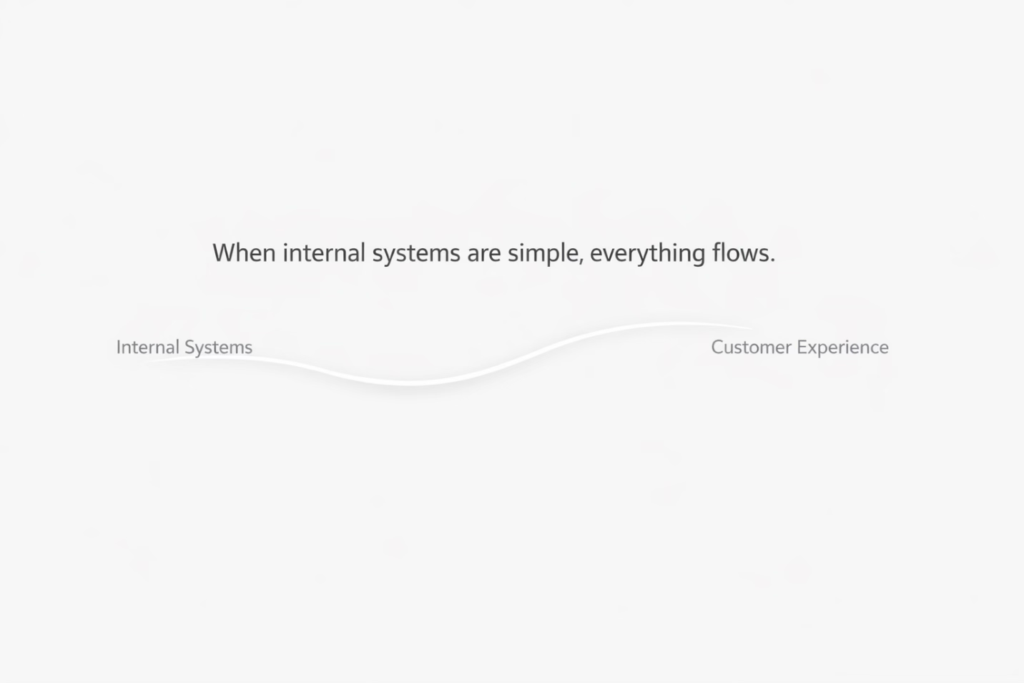
Internal Systems Shape Every Interaction
Every customer moment depends on something happening correctly behind the scenes.
Sales depends on accurate CRM data.
Support depends on complete histories.
Marketing depends on clean segmentation and reliable engagement tracking.
When internal tools are cluttered or confusing, usage declines. Activity goes unrecorded. Workflows are skipped. Over time, the system stops reflecting reality.
No polished front-end experience can compensate for broken internal foundations.
Work Happens Inside These Tools
Internal software is not occasional. It is constant.
CRMs, marketing platforms, project systems, and support tools are where teams spend their day. When those environments create friction, it multiplies across the organization.
Execution slows. Errors increase. Reporting drifts away from reality. Leadership sees one picture. Teams live another.
The gap grows quietly.
Complexity Grows Faster Than Adoption
Internal systems rarely become overwhelming overnight. Complexity accumulates.
New fields.
Additional workflows.
Layered permissions.
Edge-case features.
Soon the system can do everything, yet few people feel confident using it.
When basic tasks require training manuals, adoption drops. The tool shifts from enabling productivity to creating resistance.
Poor Usability Becomes Poor Data
Difficult systems do more than frustrate teams. They damage information quality.
If logging activity feels tedious, it gets skipped.
If workflows are unclear, data becomes inconsistent.
If inputs are unreliable, dashboards lose meaning.
Decisions are made on partial truths. Priorities drift. Customer communication becomes reactive instead of proactive.
Ease of Use Is Not Simplicity. It Is Power.
Ease of use is often misunderstood. It is not about limiting capability. It is about designing complexity so it feels effortless.
The best internal tools make the next step obvious.
They reduce cognitive load.
They conceal complexity instead of exposing it.
They support how people actually work.
Thoughtful design allows employees to focus on outcomes, not interfaces.
When internal tools are intuitive, adoption rises naturally. Data improves. Teams move faster. Customers experience consistency.
Internal Clarity Creates External Results
Adding more software rarely fixes operational friction. Clarity does.
When internal systems are clear and usable, customer performance improves automatically. Sales execution becomes steadier. Marketing becomes more precise. Support becomes more responsive.
Strong customer experiences are built on simple internal foundations.
Clarity inside the organization is not a luxury. It is a multiplier.