

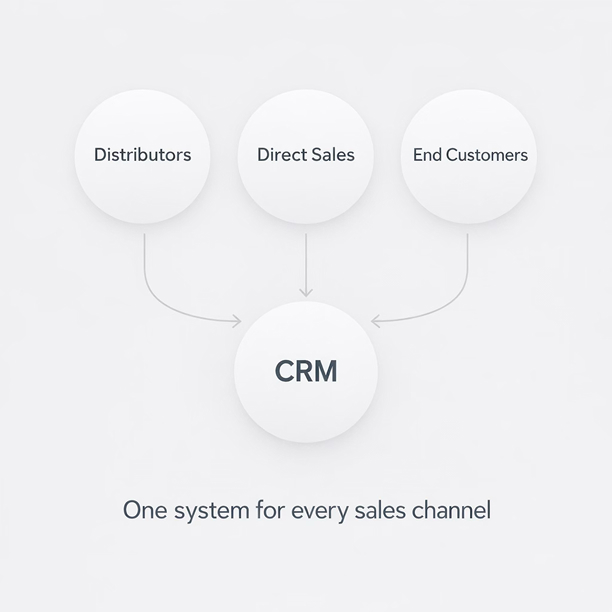
Manufacturers do not sell through one channel.
You are managing distributors, direct sales, and often end customers at the same time. When those relationships live in different systems, things break.
“Clarity replaces conflict.”
Here is how to manage distributors while keeping your entire sales ecosystem aligned inside one CRM.
Why Multi-Channel Sales Gets Messy
When systems are disconnected:
• Distributors live in spreadsheets or email
• Sales reps track deals somewhere else
• Customer requests sit in inboxes
The result:
• Channel conflict
• Missed follow ups
• Double counted pipeline
• Unreliable forecasts
This is not a people problem. It is a visibility problem.
What Your CRM Should Handle
A manufacturing CRM should bring everything into one place:
• Distributor accounts
• Direct sales opportunities
• End customer records
• Territories and ownership
• Shared activity history
When everything is visible, teams stay aligned.
1. Manage Distributor Relationships Clearly
Distributors are partners.
Your CRM should track:
• Contacts and decision makers
• Agreements and pricing
• Territories
• Performance over time
This removes the need to search through emails to understand the relationship.
2. Prevent Channel Conflict in Direct Sales
Your sales team still needs pipeline visibility, but with structure.
Your CRM should:
• Assign accounts by territory or channel
• Flag distributor owned accounts
• Prevent duplicate opportunities
• Separate direct and partner deals
This makes ownership clear and reduces friction.
3. Maintain Visibility Into End Customers
Even when distributors handle the sale, the end customer matters.
Track:
• Product usage
• Feedback
• Warranty and lifecycle data
• Expansion opportunities
Without this, you lose insight into real demand.
4. Forecast Across Every Channel
Disconnected systems lead to unreliable forecasts.
A unified CRM allows you to:
• See total pipeline across channels
• Separate distributor and direct revenue
• Forecast demand more accurately
• Identify underperforming territories
You move from guessing to understanding.
5. Align Marketing With Sales Channels
Marketing supports multiple audiences.
Your CRM should:
• Track campaign sources
• Route leads to the correct channel
• Avoid overlap between teams
• Connect engagement to accounts
This keeps communication consistent and coordinated.
6. Use One System of Record
Multiple systems create gaps.
You do not need separate tools for each channel. You need one system where everything is visible and connected.
That visibility is what enables better decisions.
Signs Your Process Is Too Fragmented
If any of these sound familiar:
• You cannot see total revenue by channel
• Teams argue over account ownership
• Forecasting requires manual exports
• Distributor performance is tracked manually
• Marketing is unsure who owns the relationship
The issue is not your team. It is your system.
The Bottom Line
Managing distributors is not just about tracking partners. It is about managing the full relationship between distributors, sales teams, and customers.
“You do not need multiple systems to manage multiple channels. You need one system that makes them visible.”
When everything lives in one place, you reduce conflict, improve forecasting, and strengthen every relationship.
Complex sales does not require complex software. It requires clarity.